Microsoft Azure AI Fundamentals (Updated Version) AI-901 Exam Questions
Preparing for the AI-901 exam is simple with CertsGate. We offer easy-to-understand study materials that help you learn the most important exam topics. You can study using our PDF questions, practice online with a real exam-style test, or use the desktop practice software. Choose the study method that works best for you and prepare at your own pace.
At CertsGate, we keep our AI-901 practice questions up to date. Whenever the exam syllabus or objectives change, we update our study materials so you always learn the latest topics. This helps you save time, avoid outdated content, and feel more confident when you take your exam.
Question #1 (Topic: demo questions)
You are developing an application that analyzes voicemail recordings by using Azure Content Understanding in Foundry Tools. You need to extract a transcript and structured information from the recordings. Which type of analyzer should you use?
Correct Answer: C
Explanation:
Voicemail recordings are audio content. Azure Content Understanding analyzers define what type of content to process, including documents, images, audio, or video, and what elements to extract, including transcripts and structured fields. Microsoft’s custom analyzer documentation also shows an audio example based on prebuilt-audio for processing customer support call recordings, which is the same content type as voicemail recordings. Therefore, to extract a transcript and structured information from voicemail recordings, you should use an audio analyzer.
Question #2 (Topic: demo questions)
What are two purposes of instructions when prompting a generative AI model? Each correct answer presents part of the solution. NOTE: Each correct selection is worth one point.
Correct Answer: A, B
Explanation:
Microsoft Foundry Agent Service documentation states that instructions define goals, constraints, and behavior for an agent. Therefore, instructions are used to guide how the generative AI model or agent should respond and behave. Option A is correct because instructions can define constraints the model must follow. Option B is correct because instructions can define the agent’s role and behavior. Options C, D, and E are incorrect because Azure region, model selection, and TPM allocation are configuration or deployment/resource settings, not purposes of prompt instructions.
Question #3 (Topic: demo questions)
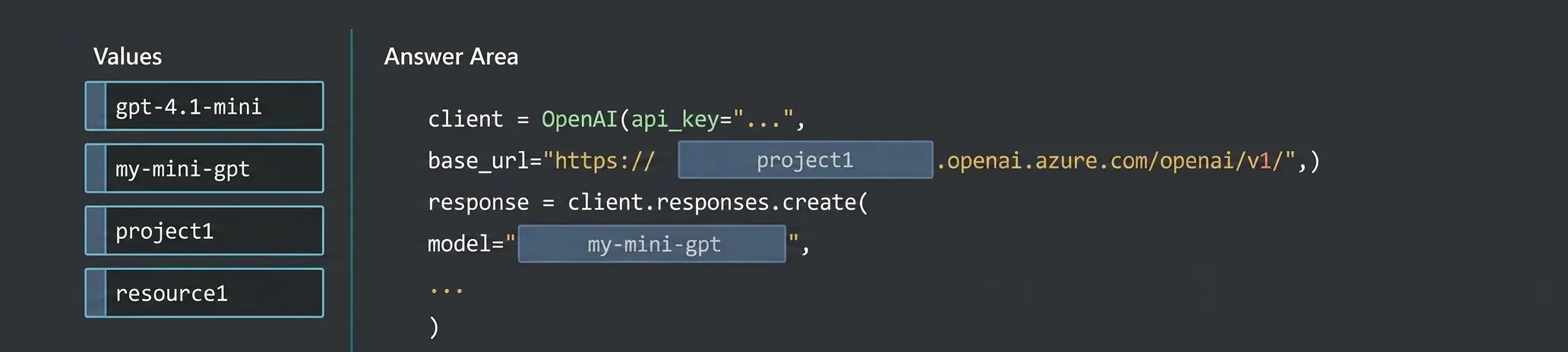
To Resource1, you deploy a gpt-4.1-mini model by using a model deployment named my-mini-gpt. You need to connect to my-mini-gpt from an application. How should you complete the Python code? To answer, drag the appropriate values to the correct targets. Each value may be used once, more than once, or not at all. NOTE: Each correct selection is worth one point.
Answer
Explanation:
client = OpenAI( api_key="...", base_url="https://resource1.openai.azure.com/openai/v1/", ) response = client.responses.create( model="my-mini-gpt", ... ) For Azure OpenAI in Microsoft Foundry, the base_url uses the Azure OpenAI resource name in the endpoint format: https://<resource-name>.openai.azure.com/openai/v1/ In the question, the Azure OpenAI resource is named Resource1, so the first blank must be resource1. Microsoft documentation for Azure OpenAI v1 endpoints confirms that the endpoint must use the ...openai.azure.com/openai/v1/ path. For the model parameter, Azure OpenAI requires the deployment name, not the underlying model name. Microsoft states that Azure OpenAI always requires the deployment name when calling APIs, even when the parameter is named model. The deployed model is gpt-4.1-mini, but the deployment name is my-mini-gpt. Therefore, the second blank must be: model="my-mini-gpt" So the correct selections are: base_url blank = resource1 model blank = my-mini-gpt
Question #4 (Topic: demo questions)
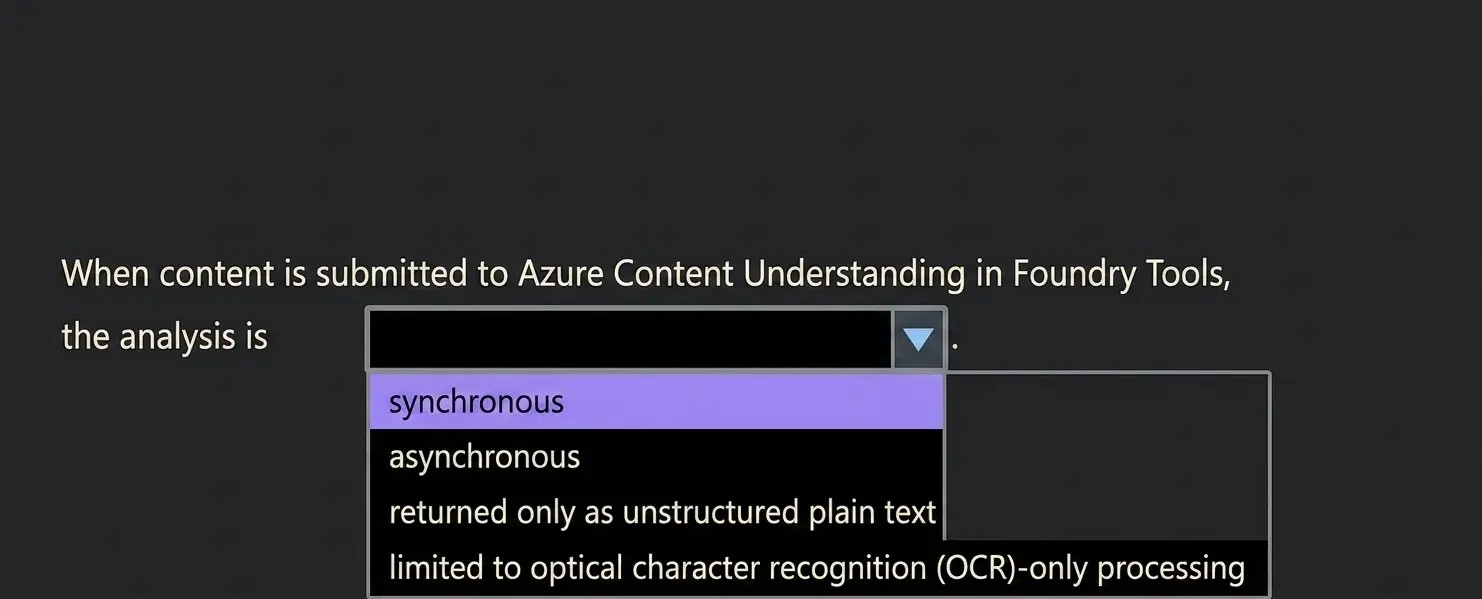
HOTSPOT Select the answer that correctly completes the sentence.
Answer
Explanation:
When content is submitted to Azure Content Understanding in Foundry Tools, the analysis is asynchronous. This means the service does not return results immediately within the same HTTP request. Instead, it uses the standard Azure long-running operation (LRO) pattern — you call begin_analyze() to submit the content, which immediately returns a poller object, and then call poller.result() to wait for processing to complete and retrieve the structured extraction results. Why the other options are wrong: Synchronous is incorrect — the analysis pipeline involves multiple AI steps (OCR, speech transcription, schema mapping) that take time; a blocking synchronous call is not supported. Returned only as unstructured plain text is incorrect — Azure Content Understanding returns richly structured JSON output with named fields mapped to your defined schema, not plain unstructured text. Limited to OCR-only processing is incorrect — Content Understanding goes far beyond OCR; it supports document, audio, image, and video analyzers, and performs semantic field extraction using AI, not just character recognition. This asynchronous design is consistent across all Azure AI services that perform complex, multi-step content processing.
Question #5 (Topic: demo questions)
You have a Microsoft Foundry project that contains an agent named Agent1. You need to ensure that Agent1 always calls an Azure function when the agent responds to user input. To what should you set tool_choice for Agent1?
Correct Answer: C
Explanation: